PARSE: Faster LLM Inference via Parallel Prefix Speculative Decoding
Speculative decoding became the standard inference speedup technique through 2024 and 2025. The idea: a small draft model generates a sequence of candidate tokens, and a larger target model verifies them in parallel — accepting the longest valid prefix and discarding the rest. The draft model is cheap; the verification pass costs roughly the same as one forward pass regardless of how many tokens you verify. It works well.
The problem is the verification step itself, when you push beyond token-level acceptance. Segment-level or semantic-level speculative approaches — where you want to verify multi-token "chunks" rather than individual tokens — have run into a structural bottleneck: they verify segments sequentially. Each segment requires a separate forward pass through the target model. The compute overhead grows with the number of segments, and the gains diminish quickly.
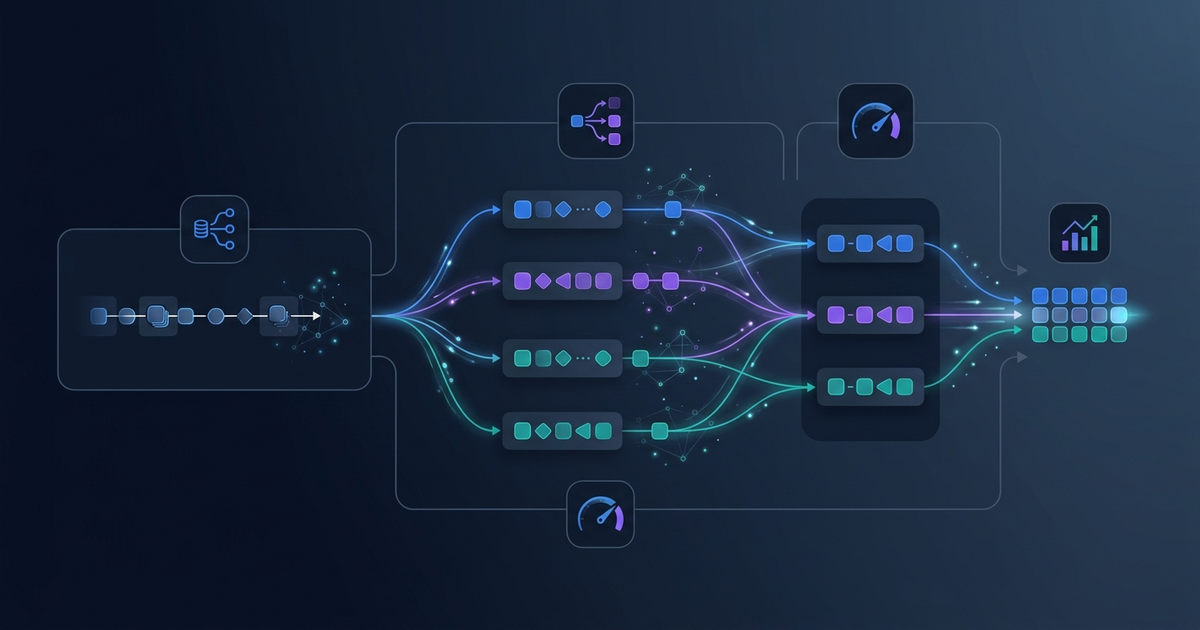
PARSE (arXiv:2605.04263) removes that bottleneck with a single observation: if you construct the right attention mask, the target model can evaluate all candidate prefixes in one forward pass, not one per prefix.
How PARSE Works
Standard speculative decoding verifies a single draft sequence: the target model runs once and identifies the maximal valid prefix. PARSE extends this to semantic prefixes — multiple candidate completions, each a different continuation of the same prompt prefix.
The trick is the attention mask. In a standard transformer forward pass, each token attends to all prior tokens in a causal pattern. PARSE constructs a custom mask that allows multiple draft prefix candidates to coexist in the same input tensor, each isolated from the others:
- Shared prompt tokens attend to each other normally (causal)
- Draft tokens for candidate prefix A attend to the shared prompt and to prior tokens in A only — never to tokens from candidate prefix B or C
The result: the target model evaluates all N candidate prefixes in a single forward pass by partitioning the attention graph. Here is a minimal Python/NumPy illustration of the mask structure (conceptual reproduction from paper description, not the authors' code):
import numpy as np

def build_parallel_prefix_mask(
    prefix_lengths: list[int],
    total_tokens: int
) -> np.ndarray:
    """
    Encodes N candidate prefixes into one forward pass by isolating
    each prefix's draft tokens from the others.
    """
    mask = np.zeros((total_tokens, total_tokens), dtype=int)
    prompt_end = min(prefix_lengths)  # shared context ends here

    # Shared prompt prefix — normal causal attention
    for i in range(prompt_end):
        for j in range(i + 1):
            mask[i, j] = 1

    # Each candidate prefix — can see shared prompt + own tokens only
    for p_len in prefix_lengths:
        for i in range(prompt_end, p_len):
            for j in range(i + 1):
                if j < prompt_end:
                    mask[i, j] = 1
                if prompt_end <= j <= i:
                    mask[i, j] = 1

    return mask

# 4-token shared prompt, 3 candidate prefixes of length 6, 7, 8
mask = build_parallel_prefix_mask([6, 7, 8], total_tokens=8)
The mask enforces that draft tokens for prefix A (indices 4–5) are invisible to draft tokens for prefix B (indices 4–6) and C (indices 4–7). Each candidate sees only its own extension. One forward pass — three independent verifications.
Performance Results
The paper evaluates across a set of standard speculative generation benchmarks. Without composition:
| Setting | Throughput vs target |
|---|---|
| Baseline speculative decoding | 1.0× (reference) |
| PARSE (standalone) | 1.25× – 4.3× |
Composed with EAGLE-3 (an existing token-level speculative decoding method):
| Setting | Throughput vs target |
|---|---|
| EAGLE-3 alone | ~1.5× – 3× |
| EAGLE-3 + PARSE | 1.6× – 4.5× |
The composition gain is additive rather than multiplicative, but it is still meaningful. PARSE addresses segment-level verification overhead; EAGLE-3 addresses token-level draft quality. The two are orthogonal, so composing them does not create conflicts.
Accuracy degradation across all tested configurations: negligible. The paper notes that the parallel mask preserves the semantics of sequential verification — the maximal valid prefix found is the same prefix the model would have found with sequential segment checking.
Why Sequential Verification Was a Bottleneck
Prior semantic speculative approaches (treating multi-token phrases as atomic units) ran sequential verification loops: check segment 1, accept or reject, if accept check segment 2, and so on. Each check is a target model forward pass. With a draft of 8 segments, you get up to 8 forward passes before knowing the final accepted output. PARSE collapses all 8 into 1.
The practical ceiling without PARSE is roughly: speedup = draft_acceptance_rate / (1 + segments × overhead_per_segment). With PARSE, the denominator's second term drops to near zero.
What Developers Need to Know
Where PARSE applies: any inference setup where the target model is the latency bottleneck and a draft model generates candidate completions. This includes self-speculative decoding (the model drafts for itself using early exit) and any multi-draft token generation scheme.
What PARSE does not change: the draft model's quality. A bad draft model still produces low-acceptance prefixes; PARSE just verifies them faster. The parallel mask helps more when the draft model generates multiple plausible alternatives and you want to pick the longest valid one without sequential passes.
Composability: PARSE is designed to be layered on top of existing speculative decoding stacks. The paper explicitly positions it as orthogonal to token-level approaches, meaning production systems can adopt it incrementally.
Code availability: as of 2026-05-11, no official implementation has been released by the authors. The attention mask construction above is a conceptual reproduction from the paper's description. Watch arXiv:2605.04263 for updates.
Context in the Speculative Decoding Landscape
Speculative decoding has evolved fast:
- 2023: Original speculative decoding (Leviathan et al.) — token-level, single draft
- 2024: EAGLE, EAGLE-2 — learned draft heads for better token acceptance
- 2025: EAGLE-3, SpecInfer variants — multi-token drafts, tree verification
- 2026: PARSE — parallel prefix verification, eliminating sequential segment overhead
PARSE is a reasonable next step in this progression. The throughput gains (1.25× at the low end, 4.5× composed) are real and consistent. The mechanism is clean and does not require modifying the target model's weights or architecture.
For teams running inference on large models where the verification pass is the bottleneck — particularly in long-form generation tasks where drafts cover multiple semantic units — PARSE is the technique to watch.
Full paper: arXiv:2605.04263.
Need content like this
for your blog?
We run AI-powered technical blogs. Start with a free 3-article pilot.