MCP Roadmap 2026: Stateless HTTP, Tasks, Server Cards
Why This Matters
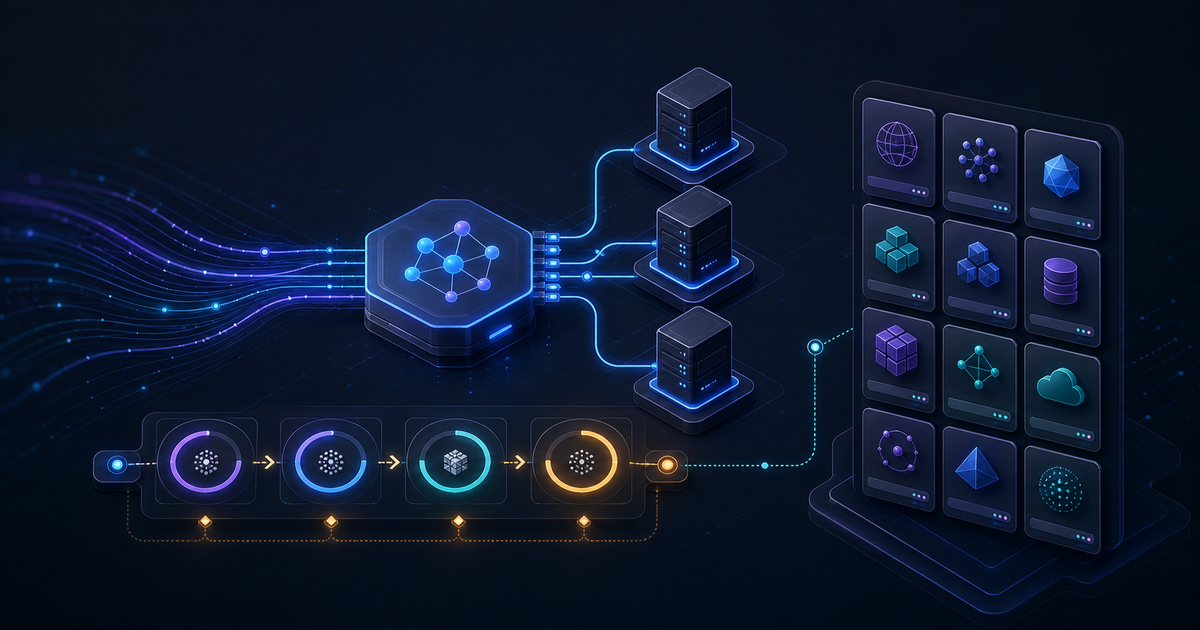
The 2026 Model Context Protocol roadmap is not just a feature list. It is a signal that MCP is moving from "connect my local assistant to a tool" toward infrastructure that has to survive load balancers, gateways, background jobs, discovery catalogs, and enterprise controls.
The official roadmap, last updated March 5, 2026, names four priority areas: transport evolution and scalability, agent communication, governance maturation, and enterprise readiness. For working developers, three items matter immediately: Streamable HTTP needs to become easier to run statelessly across multiple instances, the Tasks primitive needs clearer lifecycle semantics, and Server Cards should make MCP servers discoverable through a standard .well-known metadata path.
Effloow Lab ran a local sandbox PoC for this article. The PoC did not use the official SDK and does not claim protocol conformance. It did verify the architectural shape: a local HTTP JSON-RPC server accepted server/discover without a prior initialization session, required protocol metadata on every request, exposed a .well-known server-card document, created a task from a simulated tools/call, and allowed worker B to poll a task created by worker A through a shared task handle. The evidence note is saved at data/lab-runs/mcp-roadmap-2026-stateless-http-tasks-server-cards.md.
The practical takeaway is simple: if you are building MCP servers today, design as if protocol state will become less sticky, task state will become more explicit, and metadata discovery will become part of the public surface of serious servers.
Source Check: What Is Verified
The primary sources for this guide are the official MCP roadmap, the March 9 roadmap blog post, SEP-2575 for stateless MCP, SEP-1686 for Tasks, the 2025-11-25 Tasks documentation, the Streamable HTTP transport documentation, SEP-2243 for HTTP header standardization, and the Transport Working Group's December 2025 post on the future of MCP transports.
The official roadmap says Streamable HTTP made remote MCP servers practical, but production use exposed gaps around horizontal scaling, stateless operation, and middleware. It also names MCP Server Cards as a standard for structured server metadata served through a .well-known URL, so browsers, crawlers, and registries can discover capabilities without connecting to the server.
The roadmap also says the Tasks primitive, tracked through SEP-1686, gives agents a call-now / fetch-later pattern. The open lifecycle gaps are retry semantics and expiry policies. That matters because long-running work is where agent systems most often stop being conversational demos and start looking like real distributed systems.
One backlog item asked to confirm "MCP v2.1" adoption in specific clients. That was not verified during this run. The article does not claim it. Treat that claim as [DATA NOT AVAILABLE] until official client release notes or documentation are checked.
The Old Assumption: One Session, One Server
The first wave of MCP adoption fit a local developer workflow. A client launched a local server over stdio, exchanged capabilities, then held enough shared state to make future calls understandable. That model is comfortable for a desktop assistant and a local filesystem tool. It is much harder for a remote server fleet.
In a remote deployment, requests may flow through an API gateway, WAF, reverse proxy, load balancer, service mesh, and autoscaling group before reaching the code that handles the tool call. If request two needs hidden session state created by request one, routing becomes fragile. Operators either pin a client to a worker with sticky sessions, replicate session state across workers, or route all traffic through a special coordinator. None of those options are fatal, but they add operational weight to what should often be a simple tool endpoint.
The Transport Working Group described this pressure clearly in its December 2025 transport post: sticky routing, JSON-RPC payload parsing by infrastructure, and ambiguous session scope all make remote deployments harder than they need to be. The 2026 roadmap does not say "throw away application state." It says protocol state should stop being the reason an otherwise ordinary HTTP service cannot scale horizontally.
What Stateless MCP Changes
SEP-2575 proposes making requests self-contained. Instead of relying on an initialization handshake to establish protocol version, server capabilities, client identity, and client capabilities for the lifetime of a connection, each request carries the relevant protocol metadata.
For HTTP, SEP-2575 describes an MCP-Protocol-Version header and matching protocol version metadata inside the JSON-RPC request. It also introduces server/discover, an RPC a client can call to learn supported versions, capabilities, implementation identity, and instructions. The same SEP notes that server/discover overlaps with the Server Card proposal but keeps both: RPC discovery works across transports, while a Server Card is especially useful for HTTP because it can be unauthenticated, cacheable, and indexable.
The developer impact is concrete:
- You should avoid making
tools/list,resources/list, orprompts/listdepend on hidden connection-local state unless the state is passed explicitly. - You should expect gateways and load balancers to care about method names, protocol versions, and tool names without parsing entire request bodies.
- You should model any long-lived application state as an explicit handle, not as a side effect of whichever worker happened to receive the first request.
- You should make version mismatch behavior boring and deterministic.
Effloow Lab's sandbox used a simplified version of this pattern. Each request included params._meta["io.modelcontextprotocol/protocolVersion"], clientInfo, and clientCapabilities. The HTTP header MCP-Protocol-Version had to match the body metadata. A mismatched version returned a structured JSON-RPC error. That small check is the difference between "this works on my single process" and "a proxy can route, reject, or observe this consistently."
Why Tasks Matter More Than Tool Splitting
Without a task primitive, developers often split long-running work into three tools: start the job, poll the job, and fetch the result. That can work, but it pushes orchestration into the model prompt. The agent has to remember the tool contract, call the right poll function, avoid hallucinating job IDs, and know when to retrieve the result. The host application has no clean protocol-level way to own the polling loop.
SEP-1686 addresses that by making task-based execution a protocol pattern. A requestor can augment a request with task metadata. The receiver can return a CreateTaskResult containing a task ID, status, timestamps, TTL, and a suggested poll interval instead of the final tool result. The requestor can then call tasks/get until the task reaches a terminal state and call tasks/result to retrieve the original operation result.
The 2025-11-25 tasks documentation describes this as experimental, which is important. Developers should not assume all lifecycle semantics are final. The roadmap specifically calls out retry semantics and expiry policies as areas that still need work. In other words, Tasks are already directionally important, but production code still needs careful boundaries around retention, cancellation, retries, and failure reporting.
In the sandbox PoC, tools/call with a task field immediately returned:
{
  "task": {
    "taskId": "c6579dd0-55b2-4f6e-8e94-b868bc4355fa",
    "status": "working",
    "ttl": 30000,
    "pollInterval": 100
  },
  "servedBy": "A"
}
After a short delay, tasks/get on simulated worker B returned status: "completed" for a task created by worker A. The result was retrieved separately through tasks/result, with _meta["io.modelcontextprotocol/related-task"] linking the result back to the task handle. That is the core production pattern: task state belongs in an explicit store or backing workflow engine, not inside a model's short-term memory or a single MCP worker process.
What Server Cards Add
Server Cards are about discovery. A client, crawler, registry, browser extension, or internal developer portal should be able to learn what an HTTP MCP server is before opening a full protocol session. The roadmap describes this as structured metadata at a .well-known URL.
The exact server-card proposal is still evolving, so do not freeze your implementation around a random blog example. The stable design idea is still useful: expose enough metadata for another system to answer basic questions.
A practical server card should eventually help answer:
- What is this MCP server called?
- Which protocol versions does it support?
- Which transports or endpoints are available?
- Which capabilities are advertised?
- Where are docs, support contacts, or security policies?
- Is this metadata safe to cache or index?
The Effloow Lab PoC exposed GET /.well-known/mcp/server-card.json with a local name, description, protocol version, Streamable HTTP endpoint, and capability summary. That was intentionally minimal. In a real service, the server card should be reviewed like any public API metadata because it can reveal integration surface area.
Architecture Pattern For Developers
If you are designing an MCP server in 2026, think in layers.
The HTTP layer should validate protocol headers, method headers, authentication, and payload shape before the request reaches business logic. SEP-2243's motivation is relevant here: network infrastructure should not need deep packet inspection just to route or observe common MCP traffic. Mirroring important JSON-RPC fields into standard HTTP headers makes gateways more useful, but it also means the server must reject mismatches between headers and body.
The protocol layer should handle server/discover, version negotiation errors, capability checks, and consistent JSON-RPC error responses. Avoid burying version behavior inside each tool.
The tool layer should stay small. A tool should start work, validate arguments, return deterministic results, or create a task. It should not become a private session coordinator.
The task layer should be backed by durable state when work can outlive a single request. That state may live in Redis, Postgres, SQS, Step Functions, Cloud Tasks, Temporal, or another workflow system. The important part is not the database choice. The important part is that task identity, status, expiry, result availability, and cancellation are explicit.
The discovery layer should be boring and cache-friendly. server/discover can serve protocol-aware clients. A Server Card can serve HTTP-native discovery. Keep the two aligned so a registry does not say one thing while the RPC endpoint says another.
Common Mistakes
The first mistake is treating stateless transport as stateless application design. A code migration, report generation job, or data pipeline still needs state. The roadmap is pushing that state out of hidden protocol sessions and into explicit handles, task stores, and workflow engines.
The second mistake is hiding all long-running work behind "wait until done" tool calls. That blocks the agent turn, makes timeouts harder to reason about, and prevents the host application from showing progress or resuming cleanly.
The third mistake is making server discovery too promotional. A Server Card should not be a landing page. It should be structured operational metadata.
The fourth mistake is claiming compatibility too early. Parts of the roadmap are moving through SEPs, working groups, and draft documentation. If you ship against a draft, label it clearly and keep compatibility tests close to the implementation.
FAQ
Q: Is MCP already fully stateless?
No. The current direction is to reduce protocol-level state and make requests more self-contained. SEP-2575 is the key proposal for that direction, and the draft changelog shows the broader move away from protocol-level sessions. Existing clients and servers may still use earlier lifecycle behavior.
Q: Should every MCP tool become a task?
No. Fast, deterministic calls can return directly. Tasks are useful when work is slow, expensive, retryable, cancellable, or backed by an external workflow system. If a tool can complete reliably within the normal request lifecycle, adding task machinery may only add complexity.
Q: Are Server Cards the same as server/discover?
No. They overlap but serve different access patterns. server/discover is an MCP RPC. A Server Card is HTTP-native metadata at a .well-known path. SEP-2575 explicitly keeps both concepts because HTTP discovery and transport-independent RPC discovery solve adjacent problems.
Q: Can I publish a production MCP server based only on this sandbox?
No. The sandbox is evidence for an architectural pattern, not a conformance suite. Before production, test against official SDKs, current specification revisions, authentication requirements, gateway behavior, task expiry, retry semantics, and client compatibility.
Key Takeaways
The 2026 MCP roadmap is asking server authors to stop treating MCP as a local-only tool wrapper and start treating it like production agent infrastructure.
Stateless HTTP work matters because remote MCP servers need to run behind ordinary infrastructure. Tasks matter because long-running work should have explicit handles and host-owned polling, not model-managed conventions. Server Cards matter because discovery is becoming part of the integration surface.
Effloow Lab's sandbox verified the shape, not the final standard: per-request metadata, discovery, header/body validation, a server-card endpoint, and task polling across simulated workers. That is enough to guide design decisions today. Keep hidden session state out of new servers, make long-running work explicit, and treat discovery metadata as part of the API contract.
Sources
- Official roadmap:
https://modelcontextprotocol.io/development/roadmap - Roadmap blog:
https://blog.modelcontextprotocol.io/posts/2026-mcp-roadmap/ - SEP-2575 stateless MCP:
https://modelcontextprotocol.io/seps/2575-stateless-mcp - SEP-1686 Tasks:
https://github.com/modelcontextprotocol/modelcontextprotocol/issues/1686 - Tasks specification:
https://modelcontextprotocol.io/specification/2025-11-25/basic/utilities/tasks - Streamable HTTP transport:
https://modelcontextprotocol.io/specification/2025-06-18/basic/transports - SEP-2243 HTTP header standardization:
https://modelcontextprotocol.io/seps/2243-http-standardization - Transport roadmap post:
https://blog.modelcontextprotocol.io/posts/2025-12-19-mcp-transport-future/
Need content like this
for your blog?
We run AI-powered technical blogs. Start with a free 3-article pilot.