GPT-5.6 Programmatic Tool Calling: When It Cuts the Token Bill
Picture an assistant that answers a plain business question: "How much did we refund last week?" To answer, it calls a tool that pulls your order records, keeps the refunded ones, and adds up the amounts. The answer is a single number. But to get there, most AI assistants haul the whole pile of records back through the model, line by line, so the model can do the filtering and the arithmetic in its head.
You pay for that pile. Every record that passes through the model's reading window is billed, whether or not it shapes the final answer. One lookup is a rounding error. An agent doing this hundreds of times a day, across support tickets, billing checks, and CRM reads, turns it into a real line on the invoice.
OpenAI's newest model family, GPT-5.6, ships a feature aimed at exactly that waste. It's called programmatic tool calling. The pitch is simple: instead of reading every tool result itself, the model writes a small program that runs your tools, filters the data, and does the math off to the side, then hands the model only the finished answer.
Does it actually save money? We ran it on the live API to find out. Sometimes it saves a lot. Sometimes it costs more. The interesting part is the rule that decides which, and it comes down to one thing you can check before you commit.
What GPT-5.6 changed
On 2026-07-09 OpenAI released GPT-5.6 as three tiers you pick by cost and horsepower. Sol is aimed at the hardest work, complex coding and security research. Terra targets high-volume business tasks such as support, internal tools, and document analysis. Luna is the fast, low-cost tier for everyday drafting and routine automation. The plain name gpt-5.6 routes to Sol, and all three ship through the API (OpenAI).
The feature we're testing, programmatic tool calling, works like this in everyday terms. Normally the model asks your app for a tool result, you send it back, and the model reads it. With programmatic tool calling, the model instead writes a short piece of JavaScript that runs in a locked-down sandbox (no internet, no files, nothing saved between runs). That code calls your tools, sifts the results right there, and returns only the final number to the model. The bulky middle step never enters the part you pay for.
There's a second new trick worth naming so you can tell them apart: multi-agent orchestration, a beta feature across all GPT-5.6 models that spins up several helper agents in parallel and merges their work into one answer (OpenAI multi-agent guide). That's a different lever, more parallel effort for a stronger result, and we did not measure it here. This article is only about the token economics of programmatic tool calling.
What we built and ran
We wrote a small test that gives GPT-5.6 the same job twice: once with classic tool calling (the model reads every result) and once with programmatic tool calling (the model writes code that does the reading). Then we counted the real tokens the API reported for each. Everything is synthetic and deterministic. No customer data, no secrets, and a fixed correct answer so we can confirm the model got it right.
We used Luna, the cheapest tier, and ran two versions of the job that differ in one way only: how big each tool result is.
- Small results. A tool returns a single number. The model calls it for eight items and adds them up. Each result is a few tokens.
- Big results. A tool returns 40 order rows per call (customer, region, amount, a refunded flag, and so on). The model calls it for eight days, keeps the refunded rows, and totals them. That's 320 rows in play. In classic mode all 320 get dragged through the model; in programmatic mode they stay in the sandbox.
Both jobs have a fixed right answer (204 for the small one, 52,584 for the big one), so we can check correctness, not just cost.
What actually happened
Both approaches got both answers right. The cost is where they split apart, and they split in opposite directions depending on how big the tool results were.
When tool results were tiny, programmatic tool calling cost more, not less.
| Small tool results | Classic tool calling | Programmatic tool calling | Change |
|---|---|---|---|
| Total tokens (what you pay) | 645 | 1,392 | about 2.2x more (+116%) |
| Model output tokens | 155 | 91 | 41% fewer |
| Answer | 204 | 204 | both correct |
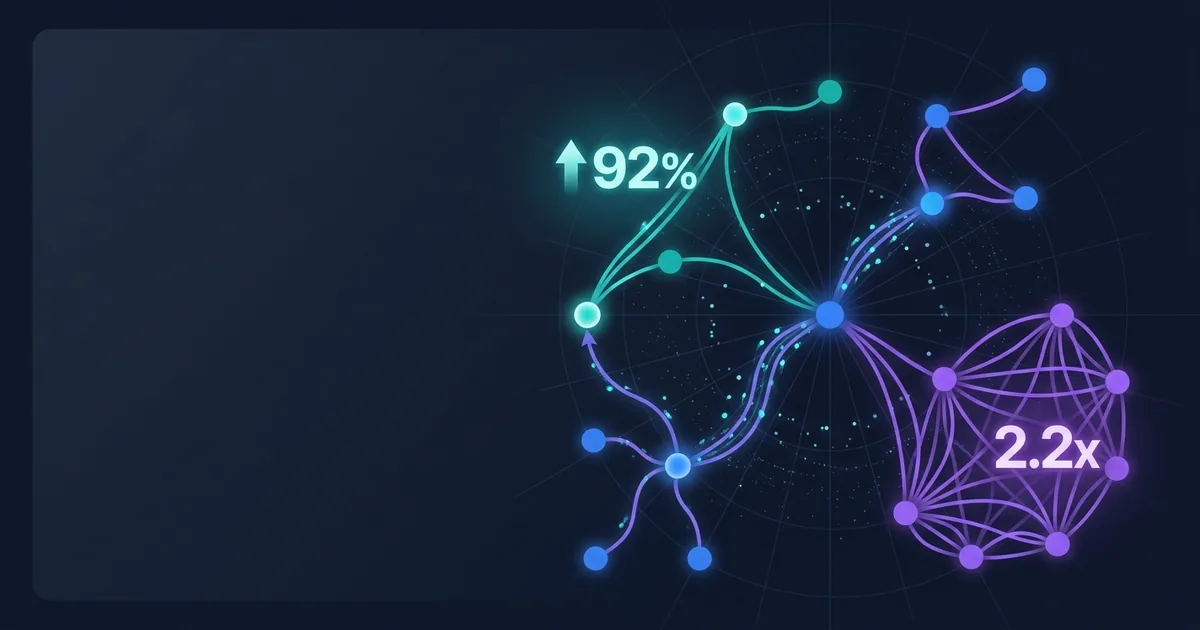
Writing the little program isn't free. The model spends tokens composing the JavaScript, and for a job this small that overhead swamps any saving. Programmatic tool calling used more than double the tokens (1,392 versus 645) to reach the same answer.
When tool results were big, programmatic tool calling was dramatically cheaper.
| Big tool results (320 rows) | Classic tool calling | Programmatic tool calling | Change |
|---|---|---|---|
| Total tokens (what you pay) | 19,491 | 1,496 | about 92% fewer (13x fewer) |
| Model output tokens | 252 | 126 | 50% fewer |
| Answer | 52,584 | 52,584 | both correct |
Here the classic approach paid to shuttle all 320 order rows through the model: 19,491 tokens. The programmatic approach kept those rows in the sandbox, filtered and summed them there, and returned only the total: 1,496 tokens. That's roughly a 92% cut (about 13 times fewer tokens) for the identical, correct answer.
So the feature is not a free discount you flip on everywhere. The deciding factor is how much data your tools hand back. Big, messy tool outputs that only need a small slice of the answer? Programmatic tool calling pays off, and it can pay off enormously. Tiny outputs, or a couple of quick calls? The overhead of writing the program can make it more expensive.
One detail is easy to misread. In both jobs the programmatic runs took more back-and-forth trips to our app, nine versus two. Our tools live in our own code, so the sandbox has to pause and ask our app to run each call. The savings don't come from cutting those trips. They come from keeping the results of those trips out of the model's reading window. Move your tools to OpenAI's side (hosted or MCP tools) and even those pauses go away.
Can this survive your workflow?
Here's how to translate the result into your own service. Ask one question: when your agent calls a tool, does it get back a lot of data it mostly throws away?
- Order and refund processing. An agent pulls a batch of orders and totals a subset (refunds, chargebacks, a region). Classic calling pays for every row. This is the big-win case, like our 92% cut.
- Support ticket triage. If a tool returns full ticket histories and the agent needs one status or one count, the history is the expensive pile that never needs to reach the model.
- CRM and billing reads. Pulling a customer's full record to answer a yes/no or a single figure is the same shape: big input, small answer.
- Internal reporting and reconciliation. Summing, counting, or matching across many rows is exactly what a sandbox program does cheaply.
When to use it, and when to skip it
You don't have to guess. Run this checklist against one agent step at a time, because the answer changes step by step rather than app by app.
Use it when all three are true:
- The tool output is bulky. Rows, records, or histories rather than a single value. Our two runs put the crossover somewhere between a handful of tokens per call and 40 rows per call, so if a step is already returning hundreds of rows you are safely on the paying side.
- The answer is much smaller than the input. A sum, a count, a match, a filtered slice. If the tool hands back 320 rows and the reply is one number, that ratio is the whole opportunity.
- The filtering is mechanical. Arithmetic, comparisons, field lookups. Anything a short script can do without judgment is work the sandbox can absorb.
Skip it when any of these hold:
- The calls are small and few. Two or three lookups that each return a short value. Writing the program costs more than it saves, which is exactly what our small-results run showed at 2.2x.
- The model genuinely needs to read everything. Summarizing every ticket is not the same job as counting them. If the reasoning depends on the full text, keeping the text out of context defeats the point.
- You can't measure the step yet. Without a before number, you cannot tell a 92% cut from a 116% increase, and both are live outcomes of the same feature.
That middle case still has a cheaper version, worth knowing before you conclude nothing can be done. Even when the model must read the data once, it does not have to keep re-reading it on every later step. We measured that separately on a browsing agent: carrying three full search results into a follow-up step billed 701 input tokens against 236 for carrying citations alone, a three-fold difference that reached the same answer. The run is in our agentic web-search context-control proof. Programmatic tool calling keeps bulk data out of context. Context trimming keeps it from being billed twice. Data-heavy agents usually want both.
The honest takeaway for a budget owner: this is a targeted tool for data-heavy agent steps, not a global setting. On the right step it can cut the model bill by an order of magnitude. On the wrong step it quietly adds cost. The way to know is to measure your own tool outputs, which is exactly the kind of bounded check we run.
If you're weighing this for a live service and want an inspectable, claim-bound proof on your own workload before you commit engineering time, that's what Effloow's Proof Studio produces. For scoping a build, see our services. We publish the method and the raw numbers every time, the same way we did here.
Limitations, in plain words
This is a bounded lab check, not a benchmark. We ran two synthetic tasks, once each per mode, on one model tier (Luna). Real numbers will move with the size of your tool outputs, how the model chooses to write its program, the reasoning effort you set, and whether your tools run on your side or OpenAI's. We did not measure price in dollars, speed, or the separate multi-agent beta. What we can stand behind: on these two deterministic tasks, on the live GPT-5.6 API, the direction and rough size of the effect were clear and reproducible with the script below.
What Effloow added
The primary sources tell you the feature exists and how to wire it up. They don't tell you when it's worth it. Our original contribution is the measured decision rule: a two-scenario, same-task comparison on the real GPT-5.6 API showing the effect flips sign with tool-output size (about 92% cheaper on big outputs, about 2.2x more expensive on tiny ones), with both answers verified correct. The full run, the exact counts, and the reproduction command are in our public lab note. This pairs with our earlier Claude programmatic tool calling token proof for a cross-model view, and sits alongside our OpenAI prompt-cache retention cost proof and OpenAI Agents SDK tool-failure recovery proof as part of a growing set of evidence-led agent-cost write-ups.
For your engineers
Model and runtime: gpt-5.6-luna via the OpenAI Responses API (POST /v1/responses). GPT-5.6 exposes gpt-5.6-sol, gpt-5.6-terra, and gpt-5.6-luna; the gpt-5.6 alias routes to Sol.
Enabling programmatic tool calling:
- Add the hosted tool
{"type": "programmatic_tool_calling"}to thetoolsarray. - On each function the program may call, set
allowed_callers: ["programmatic"](values are["direct"],["programmatic"], or both) and provide anoutput_schema. - Handle the new output items: a
programitem (generated JavaScriptcode, acall_id, and afingerprint), program-issuedfunction_callitems whosecallerfield references the program'scall_id, and aprogram_outputitem with the matchingcall_id, aresultJSON string, and astatus. Preserve everycall_idand the caller linkage when you returnfunction_call_outputitems. - Sandbox constraints per OpenAI's guide: a fresh, isolated V8 runtime with top-level
await, but no Node.js, no package install, no network, no general filesystem, no subprocess, and no persistent JavaScript state between program runs. Programs return results throughtext(...)orimage(...)and reach the outside world only through the tools you enable.
Measured results on this run (real API usage counters):
- Tiny outputs: classic 2 model round-trips, 645 total tokens, 155 output tokens; programmatic 9 round-trips, 1,392 total tokens, 91 output tokens. Answer 204 in both.
- Bulky outputs (320 rows): classic 2 round-trips, 19,491 total tokens, 252 output tokens; programmatic 9 round-trips, 1,496 total tokens, 126 output tokens. Answer 52,584 in both.
Why programmatic showed more round-trips: our tools are client-side, so the hosted program pauses for our app to execute each get_* call. Savings come from keeping tool outputs out of model context, not from reducing app round-trips; hosted or MCP tools would remove the pauses.
Reproduce: run python3 scripts/gpt56-ptc-token-proof.py. It drives both scenarios in both modes, checks the budget guard before each call (scripts/proof_budget.py, ledger in data/state/openai-token-usage.json), records real per-turn usage, and writes the artifact to data/lab-runs/gpt-5-6-programmatic-tool-calling-multiagent-token-proof-2026.openai.json. Full notes and the raw counters are in the public lab note.
Primary sources:
- Programmatic Tool Calling guide (tool config,
allowed_callers,output_schema, sandbox limits): developers.openai.com - Model guidance / latest-model doc (tier selection): developers.openai.com
- GPT-5.6 Sol announcement (release date, tier positioning): openai.com
- Responses multi-agent guide (the separate beta we did not measure): developers.openai.com
Sell an AI tool with a claim like this?
We run your tool's claim in a sandbox and hand you proof assets your buyers can check — recorded runs, failures included, and a sales-ready claim table.
More in Articles
Claude can run your tools from sandbox code so big results never hit its context. We measured what that saves on a real API: 98% fewer tokens on one task.
AI agents that browse the web re-pay for every result they read. We measured the input-token cost of context bloat on OpenAI's API: 3x on a single step.
GPT-5.6 added explicit prompt cache controls and quietly took the 24-hour cache away. We ran the API and measured what that swap costs.
How to give every customer of your AI product a hard spend cap and rate limit with LiteLLM virtual keys, before one tenant's bug becomes your bill.
Tools you can use
Build tool-calling schemas visually. Define a function and typed parameters, get ready-to-paste tool blocks for OpenAI Chat Completions, OpenAI Responses, and Anthropic Messages. 100% client-side.
Estimate token counts and API costs for your prompts across Claude, GPT-4o, and Gemini models. Real-time, client-side, no data sent to servers.
Model your LLM traffic shape against cache TTL to find your real hit rate, monthly savings, and the break-even hit rate below which prompt caching costs more.