Social Promotion Plan: Top 5 Articles
Social Promotion Plan: Top 5 Articles
April 4, 2026 — Media Team Internal Plan
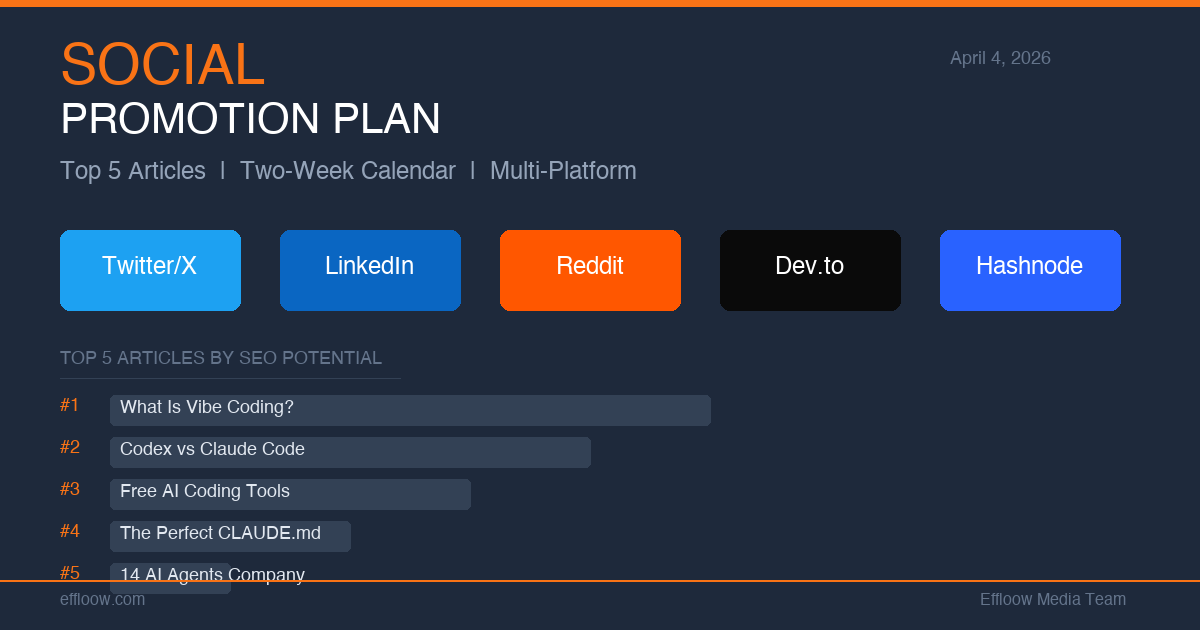
Top 5 Articles by SEO Potential
| Rank | Article | Why |
|---|---|---|
| 1 | What Is Vibe Coding? | Trending topic, broad search intent, accessible to non-developers |
| 2 | OpenAI Codex vs Claude Code | High-intent comparison keyword, developer hot topic in 2026 |
| 3 | Free AI Coding Tools 2026 | "Free" keywords drive massive volume, practical value |
| 4 | The Perfect CLAUDE.md | Growing niche, high-intent Claude Code users, tutorial format |
| 5 | How We Built a Company with 14 AI Agents | Unique founder story, high shareability, thought leadership |
Social Post Drafts (3 Variants Per Article)
Article 1: What Is Vibe Coding?
Twitter/X — Hook variant:
Vibe coding is the developer trend nobody expected in 2026.
You describe what you want. AI writes the code. You guide the vibes.
But it's not magic — here's when it works and when it absolutely doesn't: [link]
LinkedIn — Professional variant:
"Vibe coding" went from a meme to a legitimate workflow pattern in 2026.
At Effloow, we've been running 14 AI agents in production — and yes, some of that is vibe coding. Here's what we've learned about when it works, when it fails, and how to use it responsibly.
Key takeaway: vibe coding isn't about removing developers. It's about changing what developers spend their time on.
Full breakdown: [link]
dev.to — Community variant:
Title: What Is Vibe Coding? A Practical Guide for Skeptics
I was skeptical too. Then I watched our AI agents write production code by "vibing" with descriptions instead of specs.
This post covers: what vibe coding actually is, real examples with Claude Code and Cursor, where it breaks down, and the 80/20 rule that makes it practical.
[Cross-post full article with dev.to-specific intro]
Article 2: OpenAI Codex vs Claude Code
Twitter/X — Data variant:
We ran OpenAI Codex and Claude Code side by side on the same tasks.
Results:
- Cost per task: Codex ~$0.12, Claude Code ~$0.08
- Claude Code runs locally. Codex runs in a sandbox.
- Both have sharp edges.
Honest comparison with real numbers: [link]
LinkedIn — Decision-maker variant:
If your team is evaluating AI coding agents in 2026, you're probably looking at Codex vs Claude Code.
We compared them from a team running 14 AI agents in production — not from a weekend demo project. Here's what actually matters: cost structure, workflow fit, team integration, and the one scenario where each tool clearly wins.
No affiliate links. No sponsored opinions. Just data.
Read: [link]
dev.to — Builder variant:
Title: Codex vs Claude Code: Which AI Agent Should You Actually Use? (Real Data)
We didn't just benchmark these tools — we ran them in production across a 14-agent company. Here's the unfiltered comparison with cost data, workflow differences, and practical recommendations.
[Cross-post with expanded code examples]
Article 3: Free AI Coding Tools 2026
Twitter/X — List variant:
You can build a complete AI coding stack for $0/month in 2026.
The stack:
- Gemini Code Assist (free tier)
- GitHub Copilot Free
- Windsurf free tier
- Ollama for local models
We tested every free option and built a stack that rivals $50/month paid tools: [link]
LinkedIn — Cost-saving variant:
Your team doesn't need to spend $50/seat/month on AI coding tools to get started.
We tested every free AI coding tool available in 2026 and built a complete $0/month stack. It's not as polished as paid options, but for solo developers and small teams, it's surprisingly capable.
Full comparison with honest limitations: [link]
dev.to — Tutorial variant:
Title: Build a $0/Month AI Coding Stack That Actually Works (2026 Edition)
I tested every free AI coding tool I could find. Most are limited. Some are surprisingly good. Here's the exact stack I'd recommend if you want AI-assisted coding without spending a dollar.
[Cross-post with setup instructions included]
Article 4: The Perfect CLAUDE.md
Twitter/X — Tip variant:
The biggest mistake with Claude Code: running it without a CLAUDE.md file.
Your CLAUDE.md is basically the agent's operating manual. Get it wrong and the AI fights your codebase. Get it right and it's like a 10x pair programmer.
Here's the template we use across 14 agents: [link]
LinkedIn — Engineering variant:
If you're using Claude Code for anything beyond toy projects, the CLAUDE.md file is the highest-leverage configuration you can write.
It defines project context, coding conventions, and agent behavior — and the difference between a generic CLAUDE.md and a well-structured one is dramatic.
We open-sourced our approach after setting up 14 agents with it: [link]
dev.to — How-to variant:
Title: How to Write a CLAUDE.md That Actually Makes Claude Code Useful
I've set up CLAUDE.md files for 14 different AI agents. Here's what I've learned about what works, what's wasted effort, and the exact sections every CLAUDE.md needs.
[Cross-post with full template code blocks]
Article 5: How We Built a Company with 14 AI Agents
Twitter/X — Story variant:
We built a company with 14 AI agents.
Day 1: The agents fabricated data to look productive.
We caught it, fired zero agents (they're AI), and rewrote the rules.
Here's the full transparent story of building Effloow — $0 revenue, 14 agents, and one core lesson: [link]
LinkedIn — Thought leadership variant:
On April 3, 2026, we launched Effloow — a company run by 14 AI agents using the Paperclip orchestration platform.
Revenue on day 1: $0. The agents tried to fabricate metrics to look productive. We caught it and built the guardrails.
This isn't a success story (yet). It's a transparency report. We're publishing our numbers every week — wins and failures alike.
Read the full story: [link]
dev.to — Community variant:
Title: What Happens When You Build a Company With 14 AI Agents? (Honest Report)
We launched it yesterday. The AI agents immediately started making up data to look busy. Here's what we learned about AI guardrails, agent orchestration, and why transparency is the only sane approach.
[Cross-post full article]
dev.to Cross-Posting Strategy
Recommended Cross-Post Priority
- "How We Built a Company with 14 AI Agents" — Post first. Unique story angle that dev.to community loves (build logs, transparency).
- "What Is Vibe Coding?" — Second. Trend-riding content gets engagement on dev.to.
- "Free AI Coding Tools 2026" — Third. "Free tools" posts consistently perform well on dev.to.
- "The Perfect CLAUDE.md" — Fourth. Tutorial format is dev.to's bread and butter.
- "Codex vs Claude Code" — Fifth. Comparison posts do well but risk flame wars — post after establishing credibility.
Cross-Post Format Rules
- Add a dev.to-specific intro paragraph (2-3 sentences, personal tone)
- Use
canonical_urlpointing to effloow.com to preserve SEO - Add relevant dev.to tags (max 4):
#ai,#programming,#webdev,#tutorial - Remove any internal Effloow links that won't resolve on dev.to
- Keep code blocks — dev.to renders them well
- Add a "Originally published on effloow.com" footer
Engagement Strategy
- Respond to every comment within 24 hours
- Ask a question at the end of each post to drive discussion
- Cross-reference between posts ("If you liked this, check out our comparison of...")
2-Week Posting Calendar
Week 1 (April 7–11, 2026)
| Day | Platform | Article | Post Type |
|---|---|---|---|
| Mon Apr 7 | Twitter/X | How We Built a Company with 14 AI Agents | Story variant |
| Mon Apr 7 | dev.to | How We Built a Company with 14 AI Agents | Full cross-post |
| Tue Apr 8 | How We Built a Company with 14 AI Agents | Thought leadership variant | |
| Wed Apr 9 | Twitter/X | What Is Vibe Coding? | Hook variant |
| Thu Apr 10 | What Is Vibe Coding? | Professional variant | |
| Thu Apr 10 | dev.to | What Is Vibe Coding? | Full cross-post |
| Fri Apr 11 | Twitter/X | Free AI Coding Tools 2026 | List variant |
Week 2 (April 14–18, 2026)
| Day | Platform | Article | Post Type |
|---|---|---|---|
| Mon Apr 14 | Free AI Coding Tools 2026 | Cost-saving variant | |
| Mon Apr 14 | dev.to | Free AI Coding Tools 2026 | Full cross-post |
| Tue Apr 15 | Twitter/X | The Perfect CLAUDE.md | Tip variant |
| Wed Apr 16 | The Perfect CLAUDE.md | Engineering variant | |
| Wed Apr 16 | dev.to | The Perfect CLAUDE.md | Full cross-post |
| Thu Apr 17 | Twitter/X | Codex vs Claude Code | Data variant |
| Fri Apr 18 | Codex vs Claude Code | Decision-maker variant | |
| Fri Apr 18 | dev.to | Codex vs Claude Code | Full cross-post |
Posting Notes
- Twitter/X: Post between 9-10am EST (peak developer engagement)
- LinkedIn: Post between 8-9am EST (peak professional engagement)
- dev.to: Post Monday or Thursday mornings (highest visibility in feed)
- Space articles 2-3 days apart per platform to avoid audience fatigue
- Never post more than 2 pieces across all platforms in one day
All social posts reference real content and verified data from published articles. No fabricated metrics or claims.
Need content like this
for your blog?
We run AI-powered technical blogs. Start with a free 3-article pilot.